
Friday, January 16, 2015


Monday, October 27, 2014
Friday, October 24, 2014
A writing lesson: poetry of many voices
I taught a class Wednesday that I can't stop thinking about. I typed up the lesson and reflected on it here. I hope other teachers find it as student-generated, powerful, fun, and thought-provoking as we did.
Context: students have already read our core text (The First Part Last by Angela Johnson) and last night's reading was a chapter from Writing to Change the World on 'Poetic Inquiry.'
Context: students have already read our core text (The First Part Last by Angela Johnson) and last night's reading was a chapter from Writing to Change the World on 'Poetic Inquiry.'
Remediation & Meaning: Composing Activity
- Get in small groups, 3-4 I'd say is good, though one was 6 and that was fine
- Tell students: take a piece of paper, tear it into 6 pieces (any shape, any size) - write something on each of those pieces (my constraints: one thing from The First Part Last, one thing from Chapter 5, and then whatever you want on the other four. This allows some common language, some low-risk review opportunities, and for students to bring in favorite quotations/song lyrics/recent conversations/etc.)
- In their groups, students go around and share their pieces of texts
- Then, each group does their own Yankee swap (also called White Elephant, I just learned). If you haven't done one, it's that holiday game where one person starts (ex. person with next birthday) and they get to ‘choose’ one piece of writing from anyone in the group and swap it with one of theirs. Next person goes - they can ‘take back’ the piece if they want it. Third person, same, etc. So, in theory, everyone has a new piece of writing in front of them, unless they swapped back for their own piece (which, if they really liked it, is absolutely fine)
- As this is happening, I go around and I 'give’ a text to each student. This can be any bit of text - I brought in old issues of Time Magazine and tore out pages and distributed one to each student
- Students now have 1) writing pieces of their own, 2) new piece 'given to them' from someone else, 3) a piece text from me. Now, they compose a found poem. (My constraints: they have to use at least those three resources, but any part of them - a word or phrase is good). They can add anything else they want to add, and visually organize their poem how they'd like. There is no wrong answer, the point is to create a poem that organically rises from the student and their texts.
- Review and Reactions: Student shares poem with their group and gets feedback from each of the group members. If this activity goes beyond the day, you might have them revise / re-write or
- Whole-group debrief (some questions, but I think the discussion will run itself)
- what did you notice about this as 'a writing process'? how was it similar / different to what you normally do?
- what was feedback like? what did you notice about how your peers responded?
- how / why might this activity inform your writing in the future?
I can easily see this as a period-long lesson in a high school classroom (ours was part of a longer block). In about an hour, there was time to 'go find' texts for the initial six pieces (these could also be brought in for homework), time to create, time to share, time to compose, and time to reflect. I had music on for various parts of the class, and even created my own found poem from bits of their conversations.
Facilitation note: I started with whole-class directions, but then as each group set a different pace, gave the subsequent steps to them as they encountered them.
It really struck me how this lesson invited students to open up. First, they could bring in 'any text' so students wrote down movie quotations, song lyrics, what their mom said to them that morning, and so on. The sharing time was a way for them to get to know each other, and eavesdropping during the Yankee Swap produced such gems as "I'll trade your Thoreau for my 'I'm just in it right now'". There was a quiet intensity when everyone was composing their found poems - opening up the genre gave students a space to 'play' and I could go around and ask questions and nudge here and there. When groups shared back, the members could hear how 'their texts' had been incorporated into the final poem. And the discussion after, about how the experience of writing was so different than normal, reminded me that creativity and rigor don't need to be only in academic forms.
All in all, a lovely morning creating and thinking and reflecting on the nature of writing.
Sunday, July 20, 2014
The Relevance Rainbow
When commenting in the margins of student papers, I often underline the sentences after a quotation and ask ‘what does this mean - why does this matter?’ Unfortunately, my questions weren’t having an impact - students either re-phrased the quotation, provided analysis that didn’t align with their point, or simply moved on. I needed a way to help students clearly and effectively articulate the ‘take away’ from their chosen quotation.
One graphic organizer we use in my classroom is the Quote Sandwich, which helps gives structure to the elements of a paragraph. However, I wanted a graphic organizer that stripped the weight of the paragraph away so students could focus on the immediate post-quotation analysis.
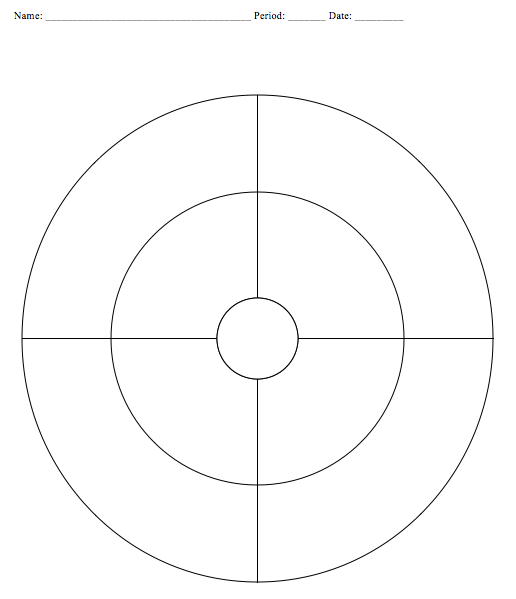
I turned to the Inference Wheel, a graphic organizer where students choose multiple quotations and write them on the inner ring, explaining what they mean in the outer ring. This structure is especially helpful for analyzing multiple quotations in a night’s reading. But it was still bulky; I wanted students to focus on breaking down one quotation and building layers of its implications.
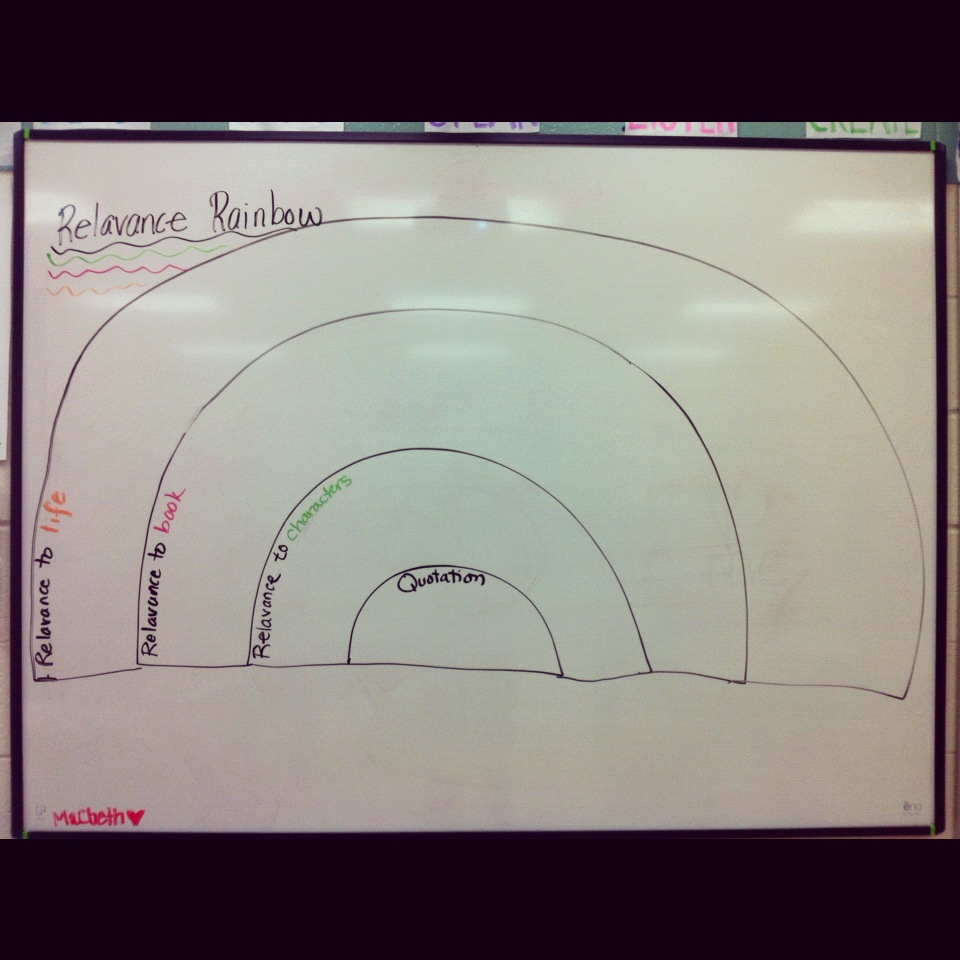
So, I tilted one ‘pie slice’ of the Quotation Wheel, and made it into a half-circle, drawing arcs above it. I labeled the levels ‘relevance to characters, relevance to book, relevance to life’ so students could scaffold their own analysis from specific to general.
I gave students either lined paper or plain paper and drew my own rainbow on the board. I like it when students create their own graphic organizers - not only do they consistently giggle while drawing - you’d be surprised at the rainbow variations - but they develop a sense of ownership over constructing their own diagram. Also, I don’t have to make photocopies. Students who like to keep their work in their notebook or on hole-punched paper can do so neatly. One drawback is that some students don’t like writing along a curve - they end up tilting the paper and doing ‘Relevance Art Deco’ with straight lines. The intellectual work of extending implications of one quotation is the same, no matter what visual variation they choose.
Once the Rainbow is on the board and on their papers, we complete one together. I choose a significant quotation from the reading the day before and start to fill out the first level, modeling why I think this line is important to the characters involved. There is space for multiple sentences of analysis, so I also ask for contributions. We move on to why the quotation matters to the book as a whole, and if it serves as a turning point, milestone, or predict how it could have an impact later on. This conversation can drift into author’s purpose as we discuss why this event happened when it did. Finally, we talk about the broader connections to life that the quotation could have, commentaries on individuals, society, etc. At the end of our discussion, I ask students to highlight the most important analysis they wrote down, which effectively annotates their own work for easy review.

When students fill out a Relevance Rainbow by themselves, there are many variations to the whole-class model that draw upon previous knowledge, collaboration, and even scaffolding towards essays.
If the final assessment is an analytical essay, completing multiple Relevance Rainbows through the unit will help students scaffold their analysis. When the essay comes, I have offered that they can choose any level and trace either a character, moments that were crucial to a plot trend, or craft a thesis about what the book says about humanity, life, etc. They can now go back through their multiple organizers, see what they wrote and what they highlighted, and construct their paper accordingly.
Giving students an accessible graphic organizer that scaffolds their analysis helps them meaningfully build levels of meaning, gives them a resource during a unit and cumulative project, and provides an effective formative assessment for teacher use.
 |
| Inference Wheel |
I turned to the Inference Wheel, a graphic organizer where students choose multiple quotations and write them on the inner ring, explaining what they mean in the outer ring. This structure is especially helpful for analyzing multiple quotations in a night’s reading. But it was still bulky; I wanted students to focus on breaking down one quotation and building layers of its implications.
So, I tilted one ‘pie slice’ of the Quotation Wheel, and made it into a half-circle, drawing arcs above it. I labeled the levels ‘relevance to characters, relevance to book, relevance to life’ so students could scaffold their own analysis from specific to general.
 |
| Relevance Rainbow |
Once the Rainbow is on the board and on their papers, we complete one together. I choose a significant quotation from the reading the day before and start to fill out the first level, modeling why I think this line is important to the characters involved. There is space for multiple sentences of analysis, so I also ask for contributions. We move on to why the quotation matters to the book as a whole, and if it serves as a turning point, milestone, or predict how it could have an impact later on. This conversation can drift into author’s purpose as we discuss why this event happened when it did. Finally, we talk about the broader connections to life that the quotation could have, commentaries on individuals, society, etc. At the end of our discussion, I ask students to highlight the most important analysis they wrote down, which effectively annotates their own work for easy review.
When students fill out a Relevance Rainbow by themselves, there are many variations to the whole-class model that draw upon previous knowledge, collaboration, and even scaffolding towards essays.
- The first two levels could serve as a reading quiz, and then launch class discussion.
- You can use it as a closing activity for students to synthesize that day’s conversation.
- As a stand-alone activity, you could choose a specific page or section, have students re-read it and pull one quotation from to analyze. For example, when reading Lord of the Flies, during the three pages when Simon dies, there are many quotations worth pulling for deeper consideration.
- In addition, students could use the graphic organizer as a form of ‘Give one, Get one’ where they choose a quotation and go around to ask what other students would say to analyze it.
If the final assessment is an analytical essay, completing multiple Relevance Rainbows through the unit will help students scaffold their analysis. When the essay comes, I have offered that they can choose any level and trace either a character, moments that were crucial to a plot trend, or craft a thesis about what the book says about humanity, life, etc. They can now go back through their multiple organizers, see what they wrote and what they highlighted, and construct their paper accordingly.
Giving students an accessible graphic organizer that scaffolds their analysis helps them meaningfully build levels of meaning, gives them a resource during a unit and cumulative project, and provides an effective formative assessment for teacher use.
Tuesday, June 17, 2014
Monday, June 16, 2014
Chancellor's Academy 2014 - Keynote
I was fortunate enough to present for the Chancellor's Academy - I talked about how intentional curriculum design can open up opportunities for student ownership of their own learning.
Here are some of the tweets from today - so many amazing people I was able to talk to!
Here are some of the tweets from today - so many amazing people I was able to talk to!
#CU2014CA @katrinakennett talks about S work mattering to them. So important!
— David Requa (@drequa) June 16, 2014@katrinakennett intentional metaphor #cu2014ca pic.twitter.com/UjzO2R8hPo
— Suzanne Linder (@linderkong) June 16, 2014Orange triangles are points of student choice @katrinakennett #cu2014ca pic.twitter.com/Ff3Ag9UOOC
— Suzanne Linder (@linderkong) June 16, 2014@katrinakennett Thank you for including metacognition as a key piece of curriculum design! #CU2014CA
— Donald Owen (@dowendo) June 16, 2014@linderkong @katrinakennett - I like how the house can take many shapes! #CU2014CA
— Matt Sly (@masly1) June 16, 2014@katrinakennett "Technologies as a social process to accomplish goals." #CU2014CA
— Matt Sly (@masly1) June 16, 2014Sunday, April 13, 2014
Saturday, January 25, 2014
The digital and non-digital: how can we move to a purposeful hybird?
I've been thinking about the "binary" between non-digital and digital learning. Instead of asking "which is better for learning," I think a more generative question might be "how do we use both to mutually inform each other - and challenge each other - to create meaningful learning
experiences?
Friday, October 11, 2013
Revising with 'Draft': Collaboration Writing & Classroom Implications
 Draft is a writing platform that strips away excess functionality to focus on the act of writing. For minimalists, this platform is designed for you: simple typeface, no visual clutter, clear and concise options. Draft also recently incorporated a 'Hemingway Mode' which turns off the functionality of the 'delete' key (I was quickly faced with how terrible a typist I am, but it did force me to keep writing, which was the point).
Draft just released an update that allows easy visual comparison of edits that someone has made on your writing. I had to edit my biography for an upcoming brunch (so this post uses an awkwardly self-serving text), and decided to test out the new features.
 I wrote my bio and imported it (Draft will sync with Drive, Dropbox, upload from your computer, and most other options you will need).
Then I made some edits, which I could compare side-by-side.
You can see the Current Version is editable, so I can still tweak while I look what I've deleted, what I've added, and how I've changed wording.

If, however, I want to have someone else revise it for me, it's easy to export the document via a link.
In this situation, I sent myself a link to edit, I edited it, and then I 'shared my edits of the original.'
While this might be confusing because I'm one lady trying to do two roles, the point is that it's easy to send a document for feedback and for the reviewer to send back edits.

Back in the role of Original Author, I'm able to see what Editor Katrina wrote. As you can see by the tri-split screen here, I'm able to accept or reject changes based on the changes themselves, but can also refer to the text to see them in context.
This way, I can judge the sentence on its own merit, or see how well it flows from and into the rest of the text.
Classroom Applications & Implications
Using Draft effectively depends on the relationship between the writer and the revisor. Often in classrooms, re-wording someone else's sentence for them could be a sign of 'doing their work for them.' With that said, what does productive collaborative writing look like in the classroom? Where are the spaces for it to happen, and when are teachers talking about how to best integrate it? The topic rarely, if ever, came up in my department meetings.
Most of my writing instruction was about productive individual writing, and I avoided assignments where students wrote together. I figured that the partnership would result in 'one student doing all of the work.' And I needed to grade them individually anyway. But how could I have used a tool like Draft, as opposed to say Google Docs, to have students give each other feedback?
Actually, I can't come up with any meaningful classroom-applicable examples. So instead, here are a few musings about why:
- School's reliance on an individual grading paradigm: Because activities must be assessed, collaborative writing activities force teachers to individually divide shared intellectual work. Using Draft as part of the writing process would prevent neat division of who wrote what for the final product.
- The real reasons authors ask for edits: Within the constraints of time, curriculum, and technology access (to list only a few), teachers can't always ask for authentic writing tasks, which in turn doesn't provide space for authentic revision processes. However, when I ask someone to look over my work, I ask because it's in progress and will be published and eventually represent me. Where is that ownership/investment in a traditional essay on Hamlet? Can we design classroom writing processes and publication spaces where students want to ask their peers and others for edits?
- Technical barriers in the time we have with students: Draft is an account-based platform, and students probably already have Google Drive set up (and, as many of us know, creating accounts can eat up half of a class period). This is not a critique for Draft - but it is of so many schools with limited technology access, compounded by what number of students don't have Internet at home. In practical terms, it's a simple tool that would not be simple for students to take advantage of.
In an ideal world (and wouldn't we all love one of those), students would add Draft to their 'technology toolbox' and be able to draw upon it as writers and editors. High school teachers could support this individual use with CCSS Writing Standard 5 & Standard 6. However, collaboration in the CCSS is only mentioned in reference to discussion, not in writing/production.
I look forward to using it in my own writing process, am delighted with every update I get from Nathan Kontny, and will continue pondering about how schools can design their space, roles, and technology to promote authentic student learning.
Wednesday, May 29, 2013
Universal Human Experience
Welcome to the end of the year! You've completed an intellectually powerful year, reading seven or more books, exploring fiction, non-fiction, poetry and a range of other texts through conversations, writing, and presenting. I can't believe it's almost June!
We have used the provocation of 'the Universal Human Experience' to frame our approach to 10th grade English. I said the frame was like an umbrella, and we touched base with it - like the prongs coming down the sides of an umbrella - each time we finished a unit.
To culminate your exploration of your selected Universal Human Experience, you will explain what it means to be human, how you came to that understanding, and why it's important to consider as we step off into the world (or at least into the summer). Explaining your argument in an EdCafe presentation, you will explain your thinking and lead a discussion on your claim. Through the process and product of this unit, you will prove that you are ready to embark on Junior Year.
For your convenience:
Link to Project Overview
Link to Plot Chart
Link to Focused Revision Sheet
Link to Overall Metacognitive Letter (due June 20 in signed hard copy)
Project Overview:
What does it mean to be human?: The Final EdCafe
A Period
C Period
F Period
Framing the Year: The Final Metacognitive Letter
We have used the provocation of 'the Universal Human Experience' to frame our approach to 10th grade English. I said the frame was like an umbrella, and we touched base with it - like the prongs coming down the sides of an umbrella - each time we finished a unit.
To culminate your exploration of your selected Universal Human Experience, you will explain what it means to be human, how you came to that understanding, and why it's important to consider as we step off into the world (or at least into the summer). Explaining your argument in an EdCafe presentation, you will explain your thinking and lead a discussion on your claim. Through the process and product of this unit, you will prove that you are ready to embark on Junior Year.
For your convenience:
Link to Project Overview
Link to Plot Chart
Link to Focused Revision Sheet
Link to Overall Metacognitive Letter (due June 20 in signed hard copy)
Project Overview:
What does it mean to be human?: The Final EdCafe
A Period
C Period
F Period
Framing the Year: The Final Metacognitive Letter
Wednesday, May 22, 2013
Senior Final Exams : Spring 2013
Congratulations! You're almost done!
The last thing you'll do for High School English is read a variety of short stories and make connections to them. Not a bad way to end 13 years of English class :)
Final Exam Preparation:
Click on the appropriate site below to read your classmates' stories.
Recommendation: Read at least four or five stories to prepare yourself for the final. You will write about three that are not your own.
 |
| Dystopian Literature |

Final Exam:
The format of this exam gives you the opportunity to demonstrate your understanding with no surprises. It's up to you to bring your best to this exam - you have choices, time, and energy enough to succeed - I look forward to your final submission.
Using your classmate's stories as your text, answer three of the five questions in short-essay form. Your mini-essay should have an introduction, at least one body paragraph, and a conclusion. You should incorporate quotations from the stories and your intellectual work (your notes, papers, books you've read, etc.)
Using your classmate's stories as your text, answer three of the five questions in short-essay form. Your mini-essay should have an introduction, at least one body paragraph, and a conclusion. You should incorporate quotations from the stories and your intellectual work (your notes, papers, books you've read, etc.)
The three mini-essays are due at the end of the your period's final (B Period on Friday, May 25, G Period on Thursday, May 30th).
Sunday, May 19, 2013
Senior Stories: Checklist for Success
Dystopian Lit
Sci Fi
Print this checklist out and check off each step as you do it to ensure your success!
Pick two buddies to check with when you have questions.
Pre-Story:
____ turned in my sticker sheets (either checked on Friday or stapled together now and handed to Ms. Kennett)
Format Your Story:
____ Title of story in center of page
____ by _____ centered below title
____ should be 1.5 spaced
____ Paragraphs are indented
____ New lines of dialogue are new paragraphs (look at a book for guidance)
____ Read out loud to find minor errors in punctuation, capitalization, etc.
Example of formatted story here
Create a 'Book Cover' for your story:
____ "I declare I cannot find my image on Google, Bing, or any other internet search engine"
____ draw a picture or take one with a camera. Add effects as you'd like.
____ email it to katrina.kennett@gmail.com or kkennett@plymouth.k12.ma.us with your name in the subject of the email. Or, hand Ms. Kennett a hard copy of your drawing
Publish Your Story to the Web:
____ Logged into professional Google Account (NOT ____@student.plymouth.k12.ma.us)
____ Click 'File'
____ 'Publish to Web...'
____ If it asks you 'are you sure?' click 'yes'
____ COPY the link it provides
Submit Your Story and your Picture:
Sci Fi
Print this checklist out and check off each step as you do it to ensure your success!
Pick two buddies to check with when you have questions.
Pre-Story:
____ turned in my sticker sheets (either checked on Friday or stapled together now and handed to Ms. Kennett)
Format Your Story:
____ Title of story in center of page
____ by _____ centered below title
____ should be 1.5 spaced
____ Paragraphs are indented
____ New lines of dialogue are new paragraphs (look at a book for guidance)
____ Read out loud to find minor errors in punctuation, capitalization, etc.
Example of formatted story here
Create a 'Book Cover' for your story:
____ "I declare I cannot find my image on Google, Bing, or any other internet search engine"
____ draw a picture or take one with a camera. Add effects as you'd like.
____ email it to katrina.kennett@gmail.com or kkennett@plymouth.k12.ma.us with your name in the subject of the email. Or, hand Ms. Kennett a hard copy of your drawing
Publish Your Story to the Web:
____ Logged into professional Google Account (NOT ____@student.plymouth.k12.ma.us)
____ Click 'File'
____ 'Publish to Web...'
____ If it asks you 'are you sure?' click 'yes'
____ COPY the link it provides
Submit Your Story and your Picture:
Wednesday, May 1, 2013
In the Aftermath of Violence: Transformation through Peace & Justice
1. Get your login from Ms. Kennett
2. Log into Scholar - Click 'Accept & Continue' and click 'next' then 'next' then 'finish.' You should have an orange notification at the top, or just click on Creator.
3. Read through the project description and start writing! (Your writing prompt is in the document below)
4. As you write / use the program, give 'real-time' feedback through the survey (also below).
5. You have until 11:30pm to finish typing in your essay...
Project timeline (all due by 11:55pm):
Write
Review / Peer Feedback
Revise
Link to document
Having trouble building an argument?
Watch Tim Wise's video 'On White Privilege'
His claim? I'd say it's something like: 'The rich elite use a visual difference (skin color) to distract from economic inequalities, creating the concept of 'race' with inherent power imbalances'
2. Log into Scholar - Click 'Accept & Continue' and click 'next' then 'next' then 'finish.' You should have an orange notification at the top, or just click on Creator.
3. Read through the project description and start writing! (Your writing prompt is in the document below)
4. As you write / use the program, give 'real-time' feedback through the survey (also below).
5. You have until 11:30pm to finish typing in your essay...
Project timeline (all due by 11:55pm):
Write
Review / Peer Feedback
Revise
Link to document
Having trouble building an argument?
Watch Tim Wise's video 'On White Privilege'
His claim? I'd say it's something like: 'The rich elite use a visual difference (skin color) to distract from economic inequalities, creating the concept of 'race' with inherent power imbalances'
Thursday, April 25, 2013
Restorative Justice - What is it and how does it connect to justice and peace?
New York Times Article - Can Forgiveness Play a Role in Criminal Justice? - Annotated
1) What is the goal of punishment? Of prisons/jails/etc.
2) Compare and contrast: punishment and consequences
3) After committing this murder, what were the punishments and consequences? Which affected him more and how/why?
Unit Word Bank:
- Justice:
- Injustice: - something that’s harmful to someone else
- Restorative justice:
- Equality // Equity:
- Security:
- Peace:
- Common good:
- Solidarity:
- Coexistence:
- Responsibility:
- Violence:
- Non-violent:
- Conflict:
- War:
- Sanction:
- Revenge:
Thursday, April 18, 2013
Thursday, April 11, 2013
Why a Formal Submission Letter Matters in the Writing Process
 When my students hand in a project or paper to me, they compose a submission letter. In the style of a formal cover letter, they learn an important professional format.
This letter, while it may vary by content, has a pretty general structure: Introduction, Reflect on Process, Reflect on Product, Conclusion/What I should know. Examples from non-fiction unit, and an essay.
I ask students to write me a letter even if they are not prepared to hand in their work that day. Their words provide a glimpse into where their work broke down, and a measure of accountability to a due date, even if they're not meeting it.
If students are late, I can use their letter as a 'to-do' list for touching base each day, jotting notes to myself about what progress they're making to complete the work. (See example below)
 |
| Students who are prepared are justifiably proud of themselves and are given the opportunity to highlight strengths that they found in this work. |
 |
| Students who will be late are given the space to explain what that have completed, and what they need to finish. It gives some positives to emphasize, even if they don't have their final paper. |
 |
| For students who don't hand their work in the next day, I make notes on what they do during class (go to the library, type, etc) and then also note when they submit the paper. The letter basically becomes a log of how I've checked in with the student and is stapled to the top of their submission. |
Wednesday, April 10, 2013
How to embed a Google Doc on your blog
For those of you submitting your letter via your blog, you will need to do some very easy coding to make it look professional. Watch this screencast to find out how to do it.
Monday, April 8, 2013
Thursday, April 4, 2013
Non-Fiction Unit - Formal Submission Letter
Dear Sophomores -
To 'hand in' your work for this unit, you will write me a formal submission letter. The purpose of this letter is to convince me that you have successfully completed the objectives of the unit. It's a great opportunity for persuasive writing - convince me what grade you think you deserve.
Below, you will find a model / suggestions for how to complete each paragraph. Concern yourself with a cohesive and articulate letter, which may mean you don't answer every single question.
This letter will be due on Wednesday. For extra credit, you can embed your letter into your blog, and add hyperlinks to your evidence of completing the standards (Pearltrees, your final product, etc). This takes a bit of patience, but will produce a beautiful final digital piece that you will be proud of.
Sincerely,
Ms. Kennett
To 'hand in' your work for this unit, you will write me a formal submission letter. The purpose of this letter is to convince me that you have successfully completed the objectives of the unit. It's a great opportunity for persuasive writing - convince me what grade you think you deserve.
Below, you will find a model / suggestions for how to complete each paragraph. Concern yourself with a cohesive and articulate letter, which may mean you don't answer every single question.
This letter will be due on Wednesday. For extra credit, you can embed your letter into your blog, and add hyperlinks to your evidence of completing the standards (Pearltrees, your final product, etc). This takes a bit of patience, but will produce a beautiful final digital piece that you will be proud of.
Sincerely,
Ms. Kennett
Saturday, March 30, 2013
Beyond 'Flipping the Classroom': Asking Students to Design their Own Learning
Too much of the teacher narrative out there is still devoted to what we do to our students. In my opinion, we need teach our students how to teach themselves.
To this end, I have recently started a new non-fiction unit with my students...
Dear Students,
 You’re embarking upon the next evolution of our year. Our non-fiction unit builds on everything we have done, but will be more challenging than your previous work. I'm excited for the next two weeks - they have the potential to fundamentally change how we approach learning and teaching for the rest of the year.
You just successfully completed your Poetry Portfolio. It was full of powerful intellectual work - you curated content, wrote thoughtfully, and compiled everything into a finished product. These Portfolios were a pleasure to read, and I thank you for giving me a glimpse into the way you connect to poetry and music and life.
With that said, our non-fiction unit will challenge you in new ways. Instead of being asked to create a static portfolio, you will 1) publish your final product on the internet, 2) design both your product and your day-to-day tasks, and 3) will use at least one technological platform. Your product and process probably won't look like your classmates, which emphasizes the self-determination you have in your own learning.
For such an independent unit, I expect you will be pushed a bit outside your comfort zone. You will need to be able to choose a goal and design backwards from it, be more comfortable with frustration, and be willing to ask for help when you’re floundering. If your confusion becomes too much, or you need to conceptualize it in more tangible terms, write out your questions or talk them out with either a friend or with me. It’s ok to get stuck, but help yourself get un-stuck.
This responsibility might be overwhelming at first, but it's meant to be empowering. In previous units, I’ve done this all for you - established the learning goals, designed the final product, and scaffolded your skills / activities to get you to that product. Now that I’m handing the bulk of this process to you.
I hope I have prepared you well for success in this unit. Consider:
- In our Macbeth unit, I decided the annotations, the work, and you chose a product to show your understanding
- For Lord of the Flies / Choice Book unit, I chose the essay format, you chose the book and the topics
- For our Poetry Portfolios, you chose the content and intellectual work (within my prompts), I determined the product
- Now, I'm choosing the overall learning goals, and you choose how to fulfill them. To help yourself, track your work habits/progress daily – this can take the form of a to-do list, a log or chart, or however you want to keep your process tangible.
Think about what you have going for you:
- a consistent emphasis on the process / product in my class
- the five ‘teacher objectives’ so you know thelearning goals
- freedom to choose a product that you’re interested in
- ability to find mentor texts that help inform your final product
- class time and technology to help your search /creation
 What will this all look like in the end? To finish the unit, you will write me a 1-2 page formal letter explaining how you have fulfilled each of the five objectives. You will attach artifacts that demonstrate how you have fulfilled these goals. Compiling an ‘application packet’ like this is good practice for the future – colleges, jobs, scholarships, presentations all ask you to thoughtfully and carefully compile your intellectual work for a high-stakes audience.
Again, I'm not only excited, but ready, for this next stage of independence in our class. You are articulate young adults who deserve the freedom and support to publish your own voice - and I feel lucky to provide that space for you.
Sincerely,
Ms. Kennett
Subscribe to:
Posts (Atom)